

 Play activities are essential to healthy development for children and adolescents. Research shows that 75% of brain development occurs after birth. The activities engaged in by children both stimulate and influence the pattern of the connections made between the nerve cells. This process influences the development of fine and gross motor skills, language, socialization, personal awareness, emotional well-being, creativity, problem-solving and learning ability.
The most important role that play can have is to help children to be active, make choices and practice actions to mastery. They should have experience with a wide variety of content (art, music, language, science, math, social relations) because each is important for the development of a complex and integrated brain. Play that links sensorimotor, cognitive and social-emotional experiences provides an ideal setting from brain development.
According to Montessori, the essential dimensions of play are:
- Voluntary, enjoyable, purposeful and spontaneous
- Creativity expanded using problem-solving skills, social skills, language skills and physical skills
- Helps expand on new ideas
- Helps the child to adapt socially
- Helps to thwart emotional problems

- Figure out how things work
- Pick up new ideas
- Build muscle control and strength
- Use their imagination
- Solve problems
- Learn to cooperate with others
Play content should come from the child’s own imagination and experiences.
Unfortunately, the play experience for today’s child is often quite different from that of their parents.
With the ever-expanding influence of electronic media including TV, videos, video games, and the internet, child are spending much of their time being passively entertained by or minimally interacting by way of a keyboard or control pad with an electronic device.
Even today’s toys are more often structured by onboard computers that dictate the play experience. This robs children of unstructured play with other kids as well as individual playtime spent in creative play. Parents need to understand the play needs of their child and provide an environment to meet those needs.
 While children do need time to play alone and with other children without adult intervention, research shows that playtime with parents is also important.
Children crave time with parents. It makes them feel special. Parents are encouraged to find time to spend playing with their kids on a regular basis. This should include one to one with each child and group time with all of the adults and kids in the home. If you are a single parent or have an only child, occasionally invite family or friends over to play.
In pretend play, let the child develop the theme. Get into their world. Let them go with it. Ask questions. Play along. Be silly along with them and have fun. Avoid over-stimulation. Know when it is time to stop.
Also, when appropriate, parents can use stuffed animals or puppets to act out real-life situations that can teach problem-solving or social skills. Let the puppet demonstrate the wrong way to handle a situation. Then, along with input from the child, act out a better way. Afterward, let the child do the same.
More Possibilities:
- Play outdoors. Throw balls. Push kids on swings. Make mud pies. Go on a hike around the neighborhood. Take a nature walk in your backyard.
- Play games – card games – board games – silly and wacky kids games. Help them learn to take turns, how to win and how to lose. Praise them. Encourage them. Laugh with them.
- Get involved in a craft project together. Build a jigsaw puzzle as a family. Bake cookies. Paint a picture.
- Listen to music together. Sing along. Play rhythm instruments along with the music. Get out the guitar or keyboard and make music.
- Read a book together. Ask questions. Ask them to change the story or make up a new one.
- Watch a movie together. Find out what they liked – how they felt. Discover the child’s interests. Comment on and discuss any bothersome content either words or actions.
- Play kid games like: Follow the Leader – Guess What I Am? – Hide and Seek
Help kids when they show the need it or ask for it. Use it as a time to teach:
- patience
- problem solving
- social skills
- creativity
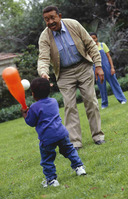
Playing with kids builds a bond that will last forever. It lets the child know he or she is loved and appreciated. It opens the door for sharing problems and concerns when the need arises. It helps the parent get to know and under the uniqueness of each child. It is also a great stress reducer for overworked parents.
Family Activities are great for the whole family. They help develop strong family bonds which can last a lifetime. It can be said that a family who plays together stays together. They also are more cooperative, supportive and have open communication. These qualities pay off in big dividends by increasing self-esteem, social skills and a sense of connectedness that helps kids and teens use good judgment when confronted with difficulties and temptations.
Family Game Night:
Here’s a great tradition that is easy to start. Pick a night and make it a family game night. Gradually add games that can be fun for the entire family. Take turns choosing the game to play. Make sure the games are appropriate for the youngest player. A great time to bond through friendly competition. Learn how to take turns and play fair. Learn how to be a good loser and well as a good winner.
Encourage Outdoor Activities

Now is the time to stop the “Couch Potato” syndrome. Pediatricians find that most kids are not getting enough exercise. Parents can be good role models by going outside and playing along with their kids. Hey, it is good for adults as well. Encourage your child to be active. Help them develop motor coordination and learn good sportsmanship.
Most children have little trouble expressing their creativity. Just ask any mother who has had to clean crayons and markers off of a freshly painted wall. Providing toys that allow your child to get creative encourage imagination and allow her to learn by doing. Creativity isn’t just about artwork. It can be expressed in a number of ways. Here are some of the best toys for encouraging creativity in your child.
Building Toys
Blocks of any kind are great for kids of all ages. They can be used to build almost anything your child can imagine. Legos allow kids to make more durable masterpieces, but it’s important to get the big ones for children who still like to put things in their mouths. There are also other types of building toys, such as the magnetic K’nex, that allow greater flexibility and different ways to build. There are even kits that allow older kids to build their own remote control cars. [Find Building Toys]
Art Toys
Drawing is a favorite activity for many children. You can encourage your budding artist by giving the toys that make it easy to express herself. Washable markers make messes more bearable. Magnetic drawing boards, Etch-a-Sketches, and other toys that allow drawing without using crayons or markers eliminate the mess altogether and are great for travel. Finger paint is a favorite of young artists, but it can be messy. Letting your kids indulge in it once in a while is good for them, and with some preparation, you can avoid any permanent damage. Smocks and lots of newspaper will protect their clothes and your table. [Find Art Toys]
Musical Toys
Music is a wonderful learning tool for children, and it’s even better when they make it themselves. You can find durable toy instruments for even the youngest budding musician. Babies love plastic tambourines, maracas, and xylophones. Toddlers and preschoolers can play a kazoo or recorder. If your child expresses great interest in the piano, beginner piano lessons might be a good investment. Children who love to sing might enjoy a karaoke machine. There are also microphones that do special effects so your little singer can sound like a pro. And there are lots of sing-a-long CDs, DVDs, and toys available. [Find Musical Toys]
Craft Kits
There are all sorts of crafts that kids can do. Kits that come with everything needed for a specific craft project make crafting easy. You could buy individual craft items and let your kids’ imaginations take over. Creativity comes naturally for kids. Giving them toys that help them express themselves is a great way to encourage them to do so. Kids who are allowed to be creative often have a greater interest in learning and as a result, they are more likely to do their best in school and life. [Find Craft Toys]